Thursday, March 13, 2014

Mid-Week Update :-)

Hello 204 Parents!
 Thank you SO much for all of the donations you have sent in… We were in dire need of supplies and you have been extremely generous! Thank you, thank you, THANK YOU! You’re the best!

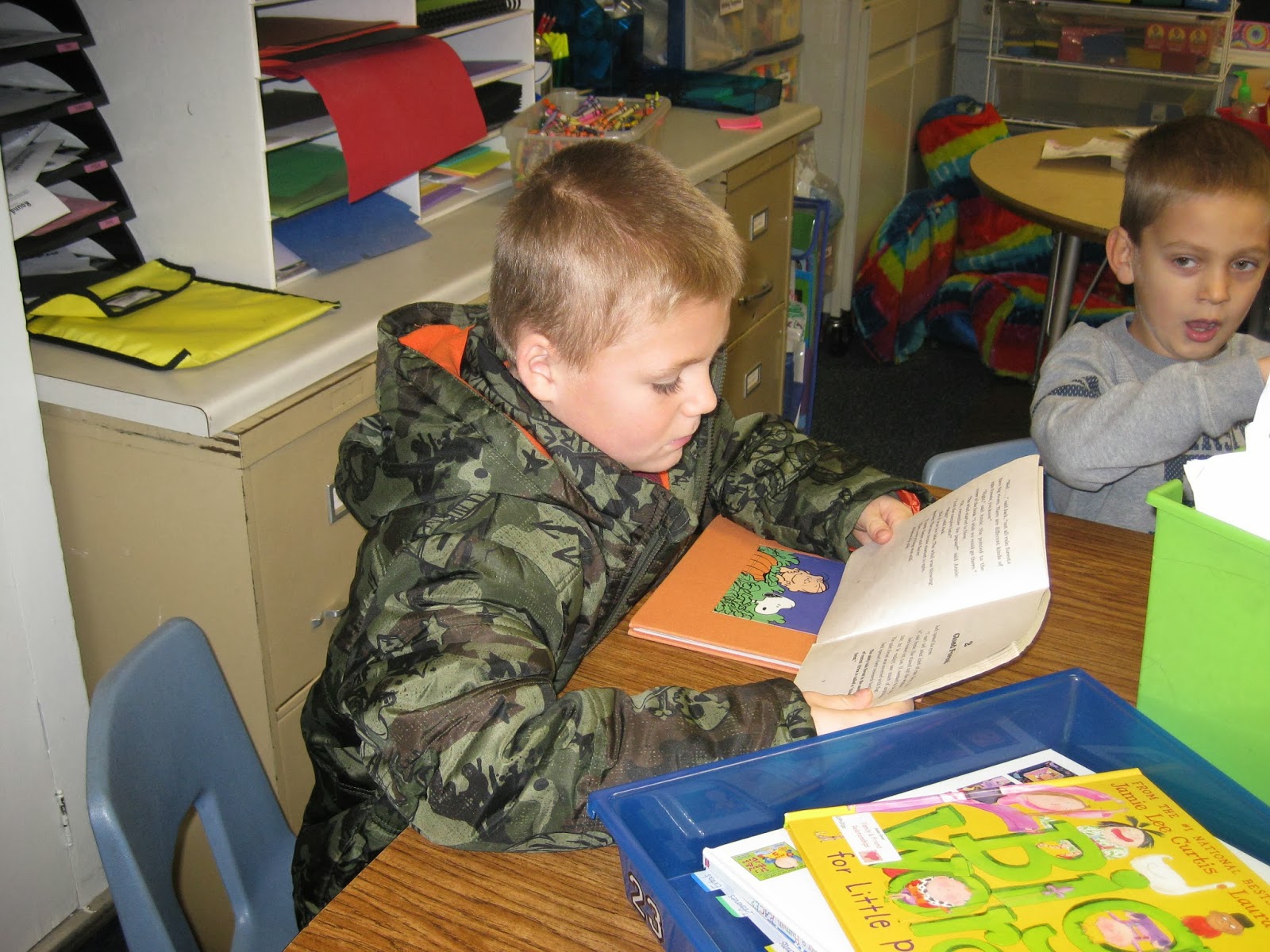
 We have also enjoyed several different Mystery Readers for March is Reading Month! It has been awesome to have familiar faces from district positions, familiar faces of former students and siblings of current students coming in to share their favorite books. It's definitely a highlight of our day! We still have days available if you or one of your family members would love to come and read to our class!

Reader’s Workshop
In Reader’s Workshop we have spent a great deal of time looking at different types of genres, we listed many and talked about how some fit under the umbrella of non-fiction and some fit under fiction, while some might fall in both categories.  The readers spent some time sorting books in their bins to find what type of genre they read and they also took a look at their reading logs too.  Some students discovered they only like to read a certain genre, others read many types of the genres.  “Mystery” was the first genre we took a closer look at.  We read a Nate the Great book and talked about how the character has a problem to solve before the end of the book.  The readers moved onto the next genre- Realistic Fiction.  Many of the readers felt they could relate to these books more than the other genres.   We pulled a previous book we read, Erandi’s Braids, to take a closer look a Historical Fiction.  The author will use a time in history, but the characters are made up from their imagination.  We finished out the week looking at Traditional Literature- these types of books might include fantasy, fairy tales, folk tales, and fables.  These are stories that are passed down from one generation to another.  Cinderella is a wonderful example of a fairy tale.  After each lesson, the students read that particular genre independently and then shared with their reading partner.  This gives the student time to explain their thinking before we do a whole group share.  As the week finishes up, we will be tallying up all of our reading genres to see what we read the most of, and which genres we need to read more of in the future!

Writer’s Workshop
It has been exciting to see students working on and putting their finishing touches on their personal narratives.  We have spent a great deal of time discussing and practicing revision and editing.  Our goal in the next few weeks is to have each child finish at least one personal narrative, having gone through each stage of the writing process.  When students share their piece with others they realize something is missing or they might also get feedback from a friend of what should be added.  We have discussed in great length what a good piece needs, it should have a good lead, beginning, middle, end, and a closing.  It’s exciting to listen and hear students helping others.  Students will be publishing these pieces too.
 We were fortunate enough to have a local author, Sandy George, come and read to our class for “March is Reading month”… We then tapped into her writing skills and she talked a great deal about the writing process. This helped our writers to realize when we draft a piece, we’ve really only just begun! It was awesome to see the detail the kids spent on their revision and editing as they could recall Mrs. George saying she spent weeks and weeks editing and revising her book!

Word Study
In Word Study we learned about adding a suffix to a word.  We added er to words.  Students learned that there are many rules to follow.   Some words doubled the last consonant, from run to runner, some just add er-- lead to leader, and other words just add the r, drive to driver.   This is very tricky, we also said that the words NEED to look right too.   Students played “Word Race” with the word chunks tr, br, dr, and cl.  The students had to look at the beginning and end of the word to solve the new word to play this game.   The next activity, Word Grid Game continued with the students looking the beginning word chunks.  Next, we learned that some words have two vowels that go together: ail, ain, and an. The vowel sound in the middle is usually the name of the first vowel.  Students brainstormed words with these patterns and then sorted more words with their phonics group.    We finished out the week by looking at the word pattern -ight-.  Students thought of many words with this pattern and played “Follow the Path”.

Math Workshop
Our mathematicians have spent the past couple of weeks learning about fractions.  Students were taught the word numerator- the number above the bar in a fraction, it tells how many parts of a group.  They also learned that the denominator means the number below the bar in a fraction, it tells the number of equal parts in all.  Many students have the concept of writing basic fractions - ½  or ¼ , and drawing the picture to represent the correct fraction.  We also worked on equivalent fractions, but many students find it tricky to find equivalent fractions and fractional parts of a group- ¼ of 20 = 5.  We finished out the week reading the book Hershey Fractions, then used Hershey candy bars to answer fraction questions, we counted fraction amounts of the colors of M and M’s in bags, and blew bubbles and kept track of the fraction of success we had.  We all had fraction FUN!!!!
The Math Benchmark study guide will be coming home soon, so please review this with your child. We are aiming to give our Math Benchmark on Thursday, March 27th.

Social Studies
Our Market Day was a huge success! We have some very creative producers and consumers in our class! The stores were jammed with items and consumers were eager to shop. We were able to write about our experiences after and incorporated in words like: goods, services, producers, consumers, opportunity cost and scarcity! The students took their social studies test last week, over all they did wonderful.  We talked how it helps to be prepared for a test- students must study, be prepared, and listen in class.
We are starting our new unit on the history of Walled Lake/White Lake.   This week we discussed what is specifically is “history”.  History is the study of the past and what happened in it.  Students take a closer look at how our area has changed over time.  Our students will have a museum of family artifacts, more information will be coming home.

Science
What a wet and crazy science week we had, we used a tub of water to explore.   Students had to make bubbles using a vial, keep a paper towel dry in a vial, pore air from one vial to another, and transfer a foam ball from one vial to another all under water.  WHEW- all in one day! The scientists realized that air takes up space. 
The scientists made a water fountain, another wet day!  The scientists explored using syringes, tubes, bottles, and water, they had to figure out in small groups how air and water can make a water fountain.  From the previous lesson, they knew about pressure and compression, very quickly the scientists had water splashing out of a syringe.  We learned… Air escapes out the open syringe as water flows in.  The water flowing into the bottle pushes air through the shorter tube and out the open syringe to make the water fountain.
The amazing meteorologists have been telling the class about the daily weather.  Thank you parents for your help!

Important Dates/Events
Friday, March 21, 2014- No School- Professional Development Day for teachers
Thursday, March 27, 2014 – Quarter 3 Math Benchmark Assessment
Friday, March 28, 2014 – Camp Read S’more (more info coming home soon J)

Friday, March 28, 2014-  End of 3rd Card Marking Period  

Monday, February 24, 2014

Monday, February 24th

Welcome back from Mid-Winter Break! We had a busy couple of weeks leading up to break and will be picking right back up from where we left off in the coming weeks! Please make sure to pay special attention to the Important Dates at the end of this news blog post.

Reader’s Workshop
In Workshop the past couple weeks we have zoomed in on text features that are helpful to us as both readers and writers! We have taken a look at transition words, juicy words, supporting details in texts and illustrations that match the text. We have used several different mentor texts to demonstrate these different features. Our students have been challenged to find their own examples in their independent and partner-reading books. Our Share Time at the end of workshop has been vital in reviewing our learning target for the day, helping students to show their understanding of the text features. As we move into our personal narrative unit in Writer’s Workshop, being familiar with: transition words, juicy words, supporting details and illustrations that match the text will help our writers’ to be more successful.

Just a reminder – goal bags are NOT expected to be returned the next day and really should remain home for several days. Please take time reviewing the book(s) in the bags and focusing in on the goal. We are setting long-term goals. So while your child might be able to for example, read with great expression noticing punctuation with the text they brought home, please keep practicing this same goal with each additional book that comes home.  Most goals are strategies students need to be practicing with an adult at home.

Writer’s Workshop
In Writer’s Workshop we have been working on drafting our own personal narratives. Students generated seed lists for different experiences and events that have happened in their own lives (such as a plane ride to visit Grandma or a trip to get ice cream on a hot summer day). Students then worked on illustrating a storyboard that gave details from the beginning, middle and ending of their stories. Next we moved our writers’ into a series of lessons about “Good Leads”. A lead is something a writer uses to hook their audience. We have been working with writing: dialogue, setting, action, sound, wondering and questioning leads for our narratives. It has been exciting to confer with your children and see all of the growth they are making in their writing. They too are eager to share their narratives with myself and with the class.

Word Study
In Word Study we have taken time to practice working on making contractions. While our students are able to piece together two words, such as I and am to make “I’m” we are also looking to see a carry through in their writing with this skill. We have spent time looking at ways to break contractions apart into two words and how to put two words into one. We also took a look at the –er and –est endings that you can add onto words. We drew pictures to illustrate this concept.  Last we took at look at writing words in the past tense where you double the consonant and add the –ed ending. Students had practicing making words where they needed to do this. An example would be “skip”. To make the word “skip” in the past tense you simply double the “p” and add “ed” to make skipped.

Math Workshop
We spent these last few weeks immersed in two and three-dimensional shapes! We have talked about the features of both two and three-dimensional shapes. We learned key vocabulary words like: parallel, line segment, vertice, vertex, side, edge and face, as well as the names of many common two and three-dimensional shapes. We have built shapes from marshmallows and toothpicks. And we have compared three-dimensional shapes in a shape museum. We have taken a lot of time in workshop to write about shapes – noticing similarities and differences between shapes. Our students took their Unit 5 Assessment right before break.

Social Studies
In Social Studies we have been focusing on resources – human, natural and capital resources. Students have learned the differences through the homemade ice cream activity we did at school right before break. We talked about all of the ingredients that went into making our ice cream as our natural resources. We talked about the people involved in making the ice cream, our human resources. Then we talked about the tools we used to do this, our capital resources. The students LOVED making their own ice cream and many asked for the recipe at home, so here goes:
In a gallon Ziploc bag, fill it half way with ice cubes and 6T of Kosher salt.
In a small, sandwich size Ziploc bag you need 1/2c. milk (white or chocolate), 1T sugar and ¼ t. vanilla.
Zip up the smaller bag and place it inside of the big bag. Then zip up the gallon sized bag and proceed to shake it for a minimum of 5 minutes. After awhile you will notice that the ingredients within the smaller bag are getting a thicker consistency. Once you are done shaking up the big bag, remove the smaller bag and wipe off all of the excess water and salt! Then, you can open the smaller bag and enjoy the ice cream treat!

Science
Air and Weather is the focus for the last science unit.  The kids explored air using cotton balls, feathers, straws, baggies, paper, styrofoam balls, and balloons.  Many interesting inventions were made… a dancing cotton ball in the baggie and sucking up the objects using the straw, just to name a few.  The next lesson we made parachutes with napkins.  We discussed how air is ALL around the parachute, which helps it to land softly. 

Important Dates/Events
Monday, February 24- SCHOOL RESUMES!
Tuesday, February 25 –
Wednesday, February 26 – Market Day in Social Studies for 203 and 204. Please make sure your child returns the bottom portion of the flyer that came home for this day. Without a parent’s signature, your child will not be able to participate in our Market Day. We will not be making phone calls home if students are missing this paper. Your child should have 10 small objects to sell for no more than $2. Please make sure all items are labeled with a price tag. They can also bring $2 with them in change for shopping purposes.
Thursday, February 27 – 100th Day of School! More info will come home, but your child will need to dress up as if they were 100 years old on Thursday! Nana Weckstein can’t wait to hang out with your old ladies and gents on Thursday. Start thinking now about those outfits – get creative and have fun!

Friday, February 28 – Economy Social Studies Test for 204. Study Guides came home before break. Please make sure your child has reviewed the concepts and is able to identify the terms in the glossary at the back of the packet. 

Monday, February 3, 2014

January News :-)

Hello Weckie Parents!! What a month of January we have been having!! Snow days, cold days, a field trip, oh my! There’s a lot of info in the blog below as well as some fun pictures from our trip to the Outdoor Center. A special thank you to the parents who helped chaperone as well as to our parents who surprised us with chocolate chip cookies and hot cocoa upon our return! A big thank you to: Mrs. Barber, Mrs. Fitrzyk, Mrs. Weedon, Mrs. Gilmore, Mrs. Smith and Mrs. Goldberg! Though we’ve had multiple disruptions this month, we have squeezed in a lot of learning! 

Click to play this Smilebox slideshow
Create your own slideshow - Powered by Smilebox
This photo slideshow customized with Smilebox

Reader’s Workshop
In the past two weeks we were able to dig deeper into character traits.  We used books by Kevin Henkes and looked closely at the characters to examine the different traits they had throughout the stories.  We found that Chrysanthemum and Wemberly Worried had both similar traits and different.  We have also almost completed all reading assessments! Soon I will be realigning our reading groups, reading partners and reading levels to fit our reader’s newest text levels.  It’s such a rewarding time of year to see the progress being made among our students.  Students will be determining and recording a new reading goal for this quarter.  The goal bags will be coming home soon to help them work towards meeting these goals.  Please know that some of the children have the same goals and it is common for a person to need continued work in one area.  Finally, we wrapped up our week making connections to stories from students’ individual book bins.  Our goal is to begin making deeper connections vs. surface ones.  These connections can draw deeper meaning from the texts.

Writer’s Workshop
We’ve taken opportunities to continue reading good literature and examining the author’s craft used in creating it.  Students continued to implement these into their own writing.  In addition, we began pushing into our next writing unit which is personal narratives.  We looked at many examples of narratives to describe what it is we will be writing.  Basically we will be writing about our own personal experiences.  This unit starts by asking students to brainstorm lists of what we call seed ideas.  We explain that a good personal narrative is more like a small seed idea that’s taken from a larger watermelon story.  For example, instead of writing about an entire trip to Michigan Adventure, we could write about the experience of riding our first rollercoaster.  Ask your child about some of his/her seed ideas.  Maybe you could make additional suggestions.

Word Study
Students were involved in several contraction lessons.  This is a lesson we will expect students to apply into daily writing.  The main target of this was that when combining two words we use an apostrophe in the spot where we remove letters.  We also worked on word chunks (ail, ain and an) and digraphs (sh, ch).

Math
It felt good to complete all of the study preparation and testing including the Benchmark Assessment!  Overall, our students performed well on this BA.  We now are beginning unit 5 (geometry).  Please know that the unit order changed with the common core.  Students learned about points and line segments and are exploring polygons thus far.

Social Studies
In our local economy unit students continue learning about producers/consumers and goods/services.  With the help of a beautiful story called Erandi’s Braids we also taught about opportunity cost.  The song we learned to help us remember it is still stuck in my head!  Of course it’s a cross between this song and the Home on the Range, as it’s the tune of the song!

Science
Our plant unit is coming to an end!  Students have truly enjoyed the hands on learning included in this unit.  Our unit test will be this coming Thursday.  Your child should have brought home a study sheet on Friday.  Please know that the grades for this unit will be on the 3rd quarter report card.
Our field trip this past week was also centered on science concepts for 2nd graders.  Mr. Reilly from the outdoor center did a great job in setting the stage for our next weather unit.

Seven Habits
Our habit focus this month is “Win-win”.  We love this one in the classroom!!!  When two or more students are having an argument or struggling with an issue, I remind them to think of a solution where everyone wins.  Try it out at home!

Important Info and Dates:
Report cards are available for viewing on February 5th.  Please take time to review your child’s successes and learning from this quarter.  I always suggest praise first and then make one goal for the next quarter.
Feb. 4th:  Dublin Staff  vs.  Commerce Staff volleyball game at 6:30pm (Walled Lake Northern) Come see Mrs. Weckstein play!!

Feb 5th:  Report Cards are available
Social Studies homework due
Feb. 14th: Valentine's Day Party
Pennies for Leukemia/Lymphoma Society due
Feb. 17th-21st: No school/Winter Break

Saturday, December 14, 2013

Friday, December 13, 2013

Friday, December 13, 2013

All the second graders have been busy these last few weeks.  The weather is getting colder and children need to be prepared for school each day.  So please help your child have boots, snow pants, hats, mittens ready each day for outside recess.   Gifts of Reading books need to be sent to school this Tuesday, December 17th to open during our winter party.

Writer’s Workshop

Our Summary unit is going strong.  We have read many books and shared many good examples of summary writing and talked about what a good summary should look like.  We used three books from the series In The Days Of the Dinosaurs, two good examples were shared with the class.  The third book had the children take a poor example and make it better.  A summary should include the beginning, middle, end, and the characters names.  We talked about The Fab Five: who, wants what, what happens, what does the main character do, and then how does it end.  These help our writers write a written summary piece about a book or chapter they have read in complete detail. The students had the chance to try out their own summary.  Before they began we talked about what makes a great summary… not telling too much for each section.


Reader’s Workshop

These past few weeks in Reader’s Workshop we shifted our focus onto punctuation we see within text. We’ve taken a specific look at the: period, comma, quotation mark, exclamation mark, question mark, hyphen, elipses, and apostrophe.  Some readers even found other punctuation marks during Reader’s Workshop to share with others.  We spent time creating a huge anchor chart about: how the punctuation mark looks, what the job of the punctuation mark is and gave examples of the punctuation mark used within text.  Our 2nd Grade Readers each created their own smaller version of this anchor chart to keep in their Reader’s Response Logs. 
We’re also beginning to a take a closer look at dialogue and strategies that help us as readers.  When students pre-read a story, they benefit greatly, it gives the reader background knowledge of the story, which helps the reader make connections and predictions even before they read the text.  Pinky and Rex books were used to look closely at dialogue. Reading partnerships had to figure out who was talking by using the many clues given in the story.  Some clues could be the simple word of said or a more complex word of muttered.   We continued to use the terms simple dialogue, no-said dialogue, and continuation dialogue when we dug deeper to figure out who was talking and how did we know?


Math Workshop

Second graders have spent a great deal of time learning different strategies to solve addition problems, these strategies include using base ten blocks pictures, partial-sum algorithms, and ballpark estimation.  The mathematicians made two animal pictures with base ten blocks.  They had to write the two numbers for each animal and then solve the difference, some kids even added the numbers together.   The mathematicians are learning to add three or more numbers together.  Students can use the number chart, draw tally marks, mental math, number line, or parts-and-total diagram.  Students practiced this skill by playing Three Addends with their math partner.  We are moving on to multiplication, which goes nicely with addition.  Students are learning about multiples of equal groups- 5 triangles = how many sides? 5x3=15 or count by 3’s.  We are beginning to build math arrays with chips, pictures, and geo boards. Our mathematicians are starting to solve multiplication problems and write the number model too.
We have been working very hard this year on basic math facts, please help your child with math facts up to 20.


Word Study

Students made connections with words that had the same ending- these are just a few examples: boxes & buses, looking & making, and rain & plain.  This continued with the next lesson where the students played Go Fish with their phonics group and had to match up word endings.  We also learned that sometimes two consonants letters stand for the consonant sound in the middle of a word.  The students played Follow the Path to read and sound out new words.  Students noticed parts of a word, which makes it easier for them to break apart the word.  We used the word part – -ink and –ing to brainstorm words with these endings.  Then the students practiced these words when they played Lotto.


Social Studies

In Social Studies we are completing our unit on the geography of our community.  We are learning about good and bad changes a community faces.  We also are working on finding absolute and relative locations on a map.  This is a challenging, but fun concept for students.  In addition to winding down this unit, we are spending a short time each week looking at winter holidays that people from our community may be celebrating.


Science

The botanists continue to observe their grass, brassica, wheat, and the potato.  The scientists are always amazed at the growth our plants are making.  These young minds are always ready to learn.   The potato has many roots and continues to grow each day.   Next week students will be challenged to make a new plant from the stem cutting of a mature plant.  If you have any plant cuttings, please send in next week.  We’ll continue to observe these over time.
                                   

Special News & Reminders

·        Monday, December 16th-Social Studies Test- Room 202 & 205
·        Thursday, December 19th - Social Studies Test- Room 203
·        Friday, December 20th - Social Studies Test- Room 204
·        Friday, December 20th  – All school sing a-long at 2:30-3:00
·        Friday, December 20th – classroom parties
·        Winter Break- December 21st- January 5th
·        School starts- January 6th

·        Thursday, January 30th – 2nd  Grade field trip to the Walled Lake Outdoor Center- more details to follow

Saturday, November 23, 2013

November 22nd

Friday, November 22nd 

Writer’s Workshop
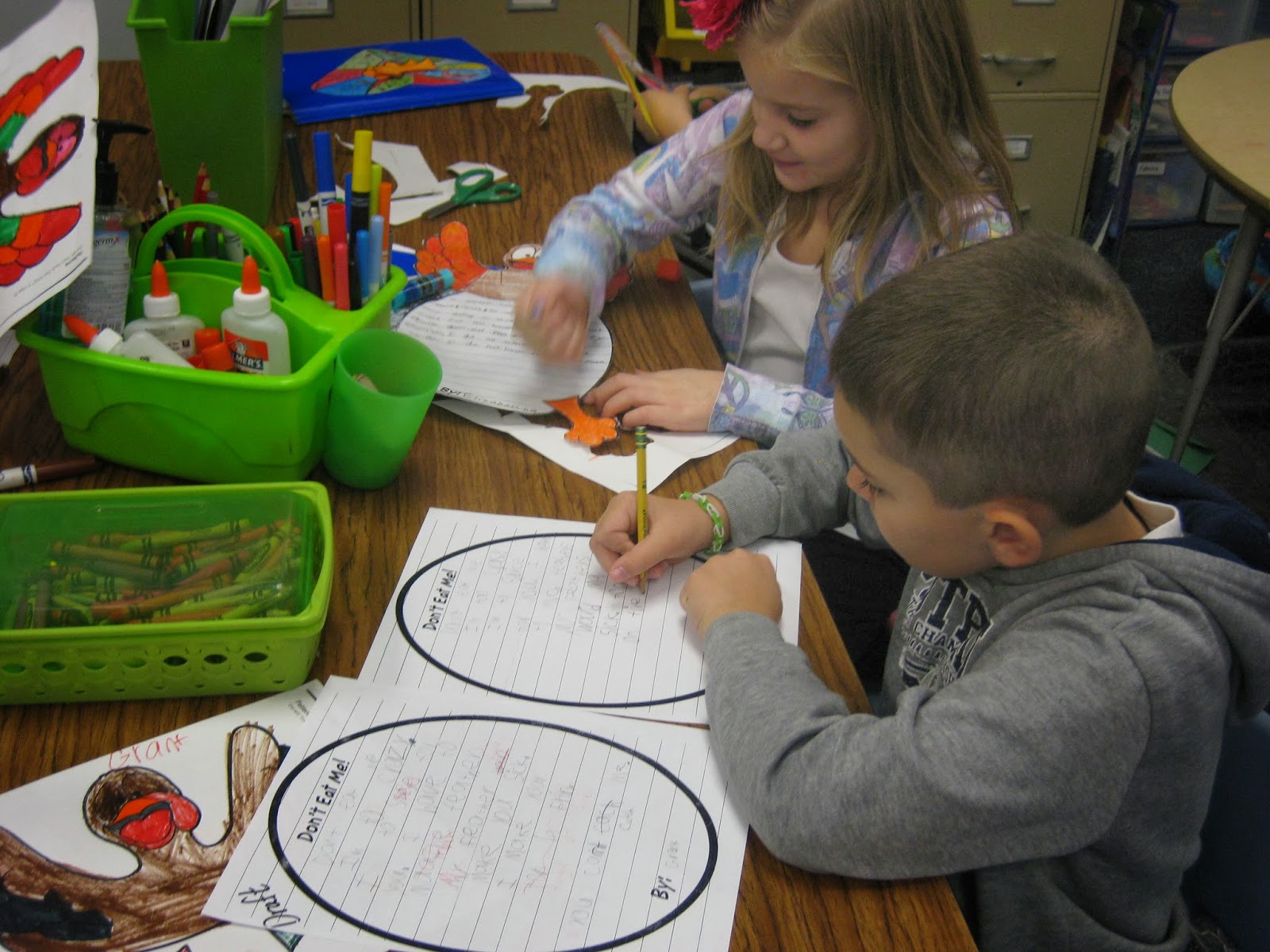
We have started working on persuasive writing.  Some of the great mentor texts we have been reading are Don’t Let the Pigeon Stay Up Late and Click Clack Moo. Your child has been working hard on their persuasive piece all week. They pretended that they were a turkey and had to persuade people not to eat them for Thanksgiving. They did a wonderful job, and we have hung them in the hallway. We will continue to work on persuasive writing next week. Next, your child will be choosing the topic and whom they would like to persuade.
       
Reader’s Workshop
We are finishing up our study of dialogue.  Your child has been working hard on being a reading detective.  Students searched their books during independent reading for examples of different types of dialogue. They learned about simple dialogue, no-said dialogue, and continuation dialogue. We noticed one book can have all three different types of dialogue such as Junie B Jones and Henry and Mudge! They have also learned the difference between 1st person dialogue and 3rd person dialogue. We will now be starting our punctuation unit. Your child will be learning the names of punctuation marks, what the punctuation marks looks like, the job of the punctuation marks, and examples from different texts.


Math Workshop
We have begun unit four by taking the unit four pre-test. We are working on story problems and different ways to solve them. They have learned Change-to-More diagrams and Parts-and-Total diagrams to help them organize and solve the story problems. Many of our story problems have involved temperature changes. Your child has learned about degrees Fahrenheit, degrees Celsius, and degree marks. Another math strategy we have been working on is using estimation to solve problems. We have done this by using Ballpark Estimation. This can be a difficult concept to learn, please continue to do HomeLinks with your child.


Word Study
We continued learning about Onsets and Rimes by looking at words that end in -ice, -ide, and –ine. Then, we reviewed high frequency words by playing Follow the Path. We also learned what antonyms are. They played Concentration, which is like Memory using antonyms. We finished up the week with talking about syllables. Students played Syllable Lotto. They also learned how to make singular words plural using -s and -es endings.                      

Social Studies
We are working on the Geography of Our Community Unit. As cartographers, we made a pirate map of where there is buried treasure. We also learned about man-made features and natural features on a map.


Special News & Reminders
·        Thursday, November 28th – NO SCHOOL – Happy Thanksgiving!
·        Friday, November 29th – NO SCHOOL

·        Monday, December 2nd - NO SCHOOL

Monday, November 11, 2013

Friday Nov. 8th

Friday, November 8th
Writer’s Workshop
We started the week by reading Hailstones and Halibut Bones by Mary O’Neill.  It’s a book that is filled with color poems!  Each poem demonstrated different ways to think about colors using your senses… How would a color look? How would a color taste? How would a color feel? How would a color smell? Using the author’s craft from these poems, we have been working to create our own color poems.  Our poets also selected one of their favorite poetry pieces to bring to publication.  They edited and revised their poems to make them “just right” and conferenced with the teacher.  On Friday afternoon, all of the second grade classes were divided into four groups.  They took their poems to share with other second grade friends during our Second Grade Poetry Jam.  Thanks to all of you who donated water bottles or Oreo cookies…they were delicious!  We’ll be working on persuasive writing pieces during the next few weeks.

Reader’s Workshop
We are beginning our study of dialogue.  Your child should be able to tell you what dialogue is and what types of books have it.  Students searched their books during independent reading for examples of dialogue.  They also are learning about patterns of books that use dialogue.  We used Cynthia Rylant and Kate DiCamillo books to compare how authors choose to use or not to use dialogue in a book.  It was interesting to see that her series Mr. Putter and Tabby  uses no or very little dialogue in them while Henry and Mudge books seemed full of dialogue.  Additionally, we spent time looking for ways writer’s use “said” alternatives in texts. We brainstormed a giant web of different words for “said” and nearly found over 25 variations! We spent time looking at how these ‘alternatives’ can influence how we read a passage, such as if a character whispered or yelled. Students spent time acting out passages from their texts to continue their look into dialogue and using contextual clues from the author to signal dialect changes. Last we spent time looking to see if all books have dialogue. We made some big generalizations, such as non-fiction tends to not have dialogue while chapter books are loaded with conversations.
Math Workshop
Assessments, assessments, assessments!  At the beginning of the week, we reviewed for and our students took their first Benchmark Assessment.  Families will receive the scores during parent teacher conferences.  I was impressed with how well our class scored!  Mid-week, we reviewed making change by counting up.  Making change is a difficult concept. It’s something that needs to be reviewed often at home in order for mastery.  We ended our week by taking the end of the unit assessment for Unit 3.  Our next unit will focus on addition and subtraction facts.
Word Study
We began the week looking at words that have “oo”. Students learned that “oo” can sound like /oo/ as in moon or /uh/ as in look. We also tried adding on the silent ‘e’ to words to see how new words could be created. We ended the week by looking at words with the –am, -ate and –ake word endings.

Social Studies
Our second graders reviewed the cardinal directions and the use of a compass rose. We learned the acronym: “Never Eat Soggy Waffles” to help us remember the cardinal directions. Next, we explored the different elements and uses of maps through some hands-on stations.  As cartographers we used and atlas and explored, globes, and various types of maps.   Students will be given a homework assignment earlier that requires them to draw a map of their bedroom.  These maps will be due on Monday, November 18th.
Special News & Reminders
·        We have been blogging... check it out! http://www.classblogmeister.com/blog_edit.php?userid=118873

·        Thursday, November 14th  – NO SCHOOL – Parent/Teacher Conferences All Day
·        Wednesday, November 20th  – Bedroom Map DUE